By: Bishop Sara of Impudence and Sunshine
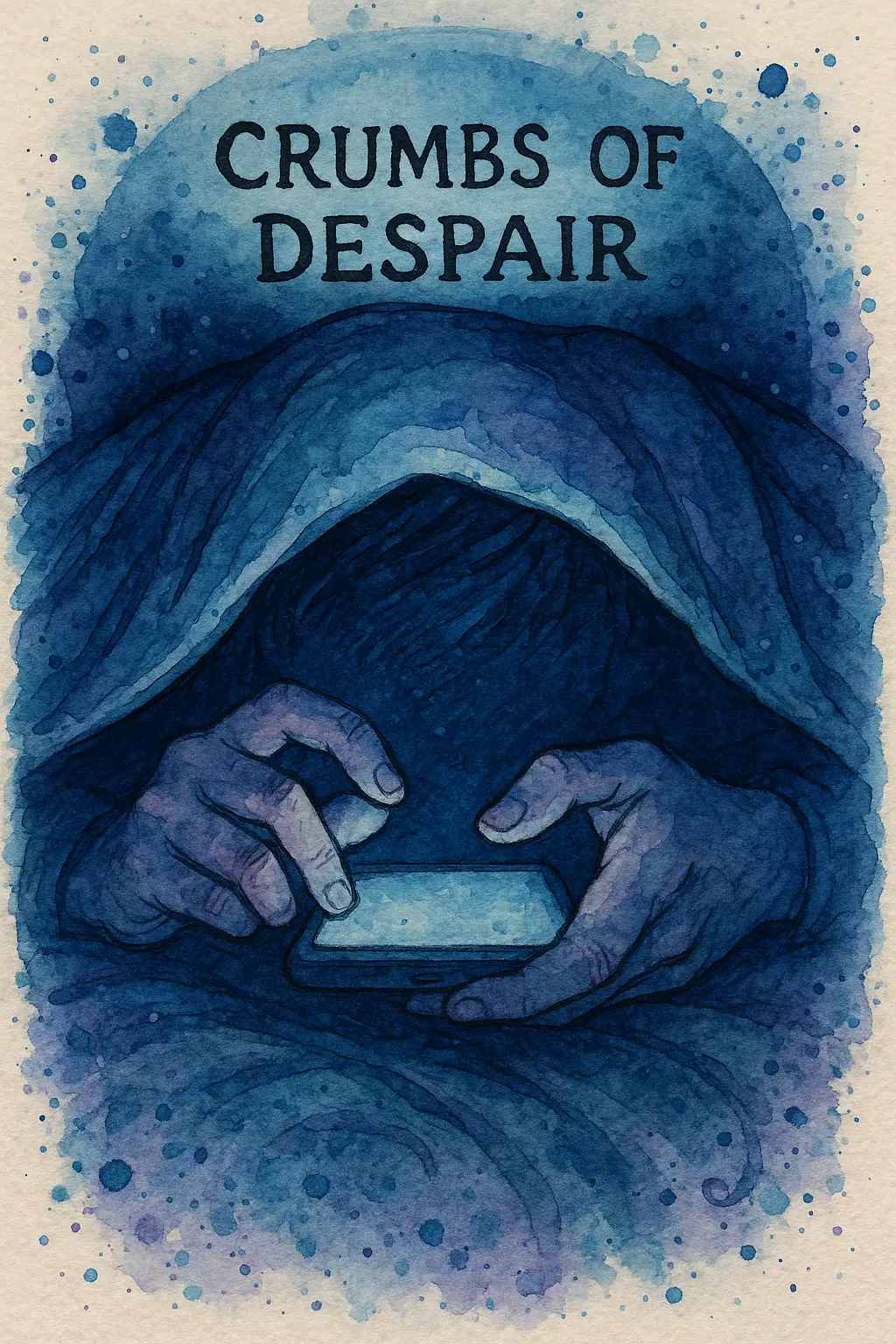
There’s a special kind of shame that comes from realizing you’ve been doomscrolling for three hours and are now an expert on both 14th-century eel mating rituals and the latest congressional shutdown. We tell ourselves, “I’m just staying informed.” Lies. Doomscrolling is emotional junk food: it doesn’t fill you, it just leaves crumbs of despair everywhere.
The problem isn’t that you have no willpower. The problem is that doomscrolling works—at least temporarily. The brain gets a hit of control, like “If I just know everything, I’ll be safe.” Except the universe does not, in fact, reward you with safety points for reading 37 think pieces on economic collapse before breakfast.
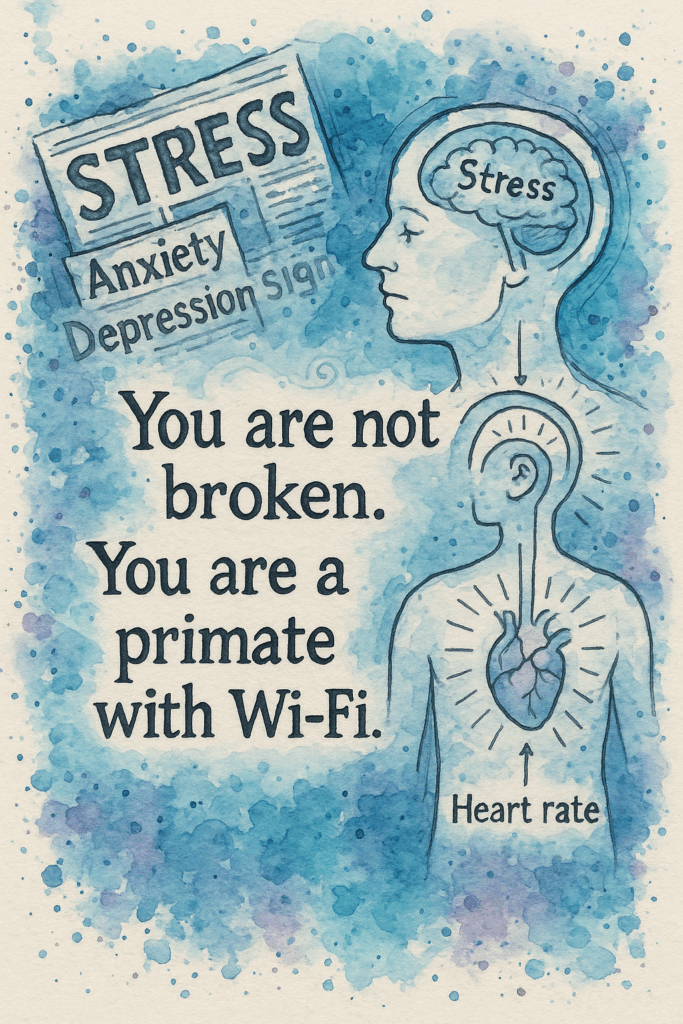
Science agrees, by the way: doomscrolling correlates with higher stress, anxiety, and even physical health issues (Dixon, 2021; Oeldorf-Hirsch & Sundar, 2023). Translation: you’re not broken, you’re just a primate with Wi-Fi.
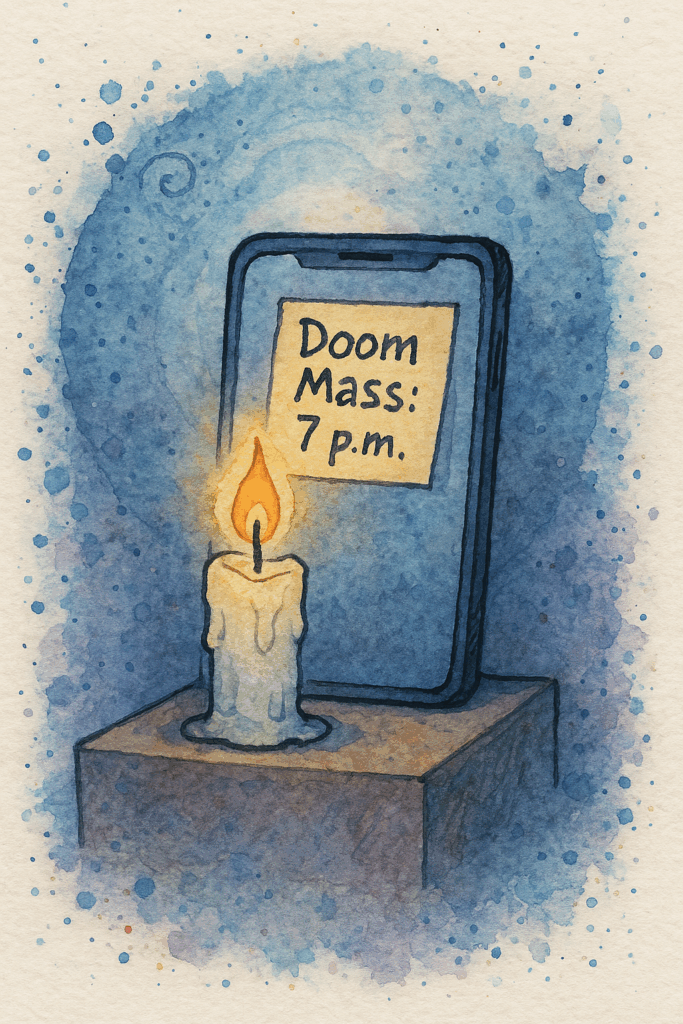
So here’s our Cult of Brighter Days hack: treat doomscrolling like a liturgy. Light a candle, doomscroll at a scheduled hour, say a small prayer for your sanity, then shut it down. Call it the Doom Mass. It’s like church, but with fewer hymns and more memes.
AI, Playlists, and Group Chats = Survival Tech
Tech is not just the villain. Used creatively, it’s holy mischief.
- AI is not your oracle. It’s your office fern. Vent into it, ask it nonsense, let it absorb your existential dread. Sometimes it even helps you outline your grocery list or bounce ideas off of to generate a blog article. (Also, expressive writing literally lowers stress — Pennebaker & Smyth, 2016 — even if your “journal” is an algorithm that keeps offering you dad jokes.)
- Playlists are the modern psalms. The right playlist can get you through rage-cleaning, ugly-crying in the shower, or pretending you’re in a music video while staring out a bus window. Science backs it: music is basically mood regulation on tap (Saarikallio & Erkkilä, 2007). So yes, your angsty “2004 Emo Revival” playlist is technically healthcare.
- Group chats are digital monasteries. Your friends sending “drink water” texts at 2 a.m.? That’s the night watch. The meme dropped in the chat after a bad day? That’s the daily bread. Social support is consistently proven to buffer stress and improve well-being (Taylor, 2011). Your “chaotic besties” thread is basically public health infrastructure.
Notifications: The Monastic Discipline
The holiest button on your phone is Do Not Disturb. Turning off notifications is the digital vow of silence. Monks used to retreat to caves. You? You just put your phone face-down and trust that the world won’t explode without you. Spoiler: it won’t.
Also: digital minimalism isn’t just trendy influencer content. Research shows that constant notifications tank your focus and spike your stress (Mark et al., 2016). So yes, muting Slack at 5 p.m. is less rebellion and more self-preservation.
In the Cult of Brighter Days, we don’t just encourage silence—we encourage selective silence. If your boss can wait until 9 a.m. tomorrow, the ping can too. If your group chat demands an instant hot take, they’ll survive on memes until you return.
Closing Benediction
Tech is not inherently good or evil; it’s a tool. It can chain you to despair or tether you to joy. The trick is intention, ritual, and a bit of rebellion.
So, beloved doomscrollers, may your newsfeeds be merciful, your playlists be blessed, your AI remain charmingly mediocre, and your notifications forever snoozed.
Go forth and cope—digitally, creatively, and with holy mischief.