(Spoiler: Usually Not You.)
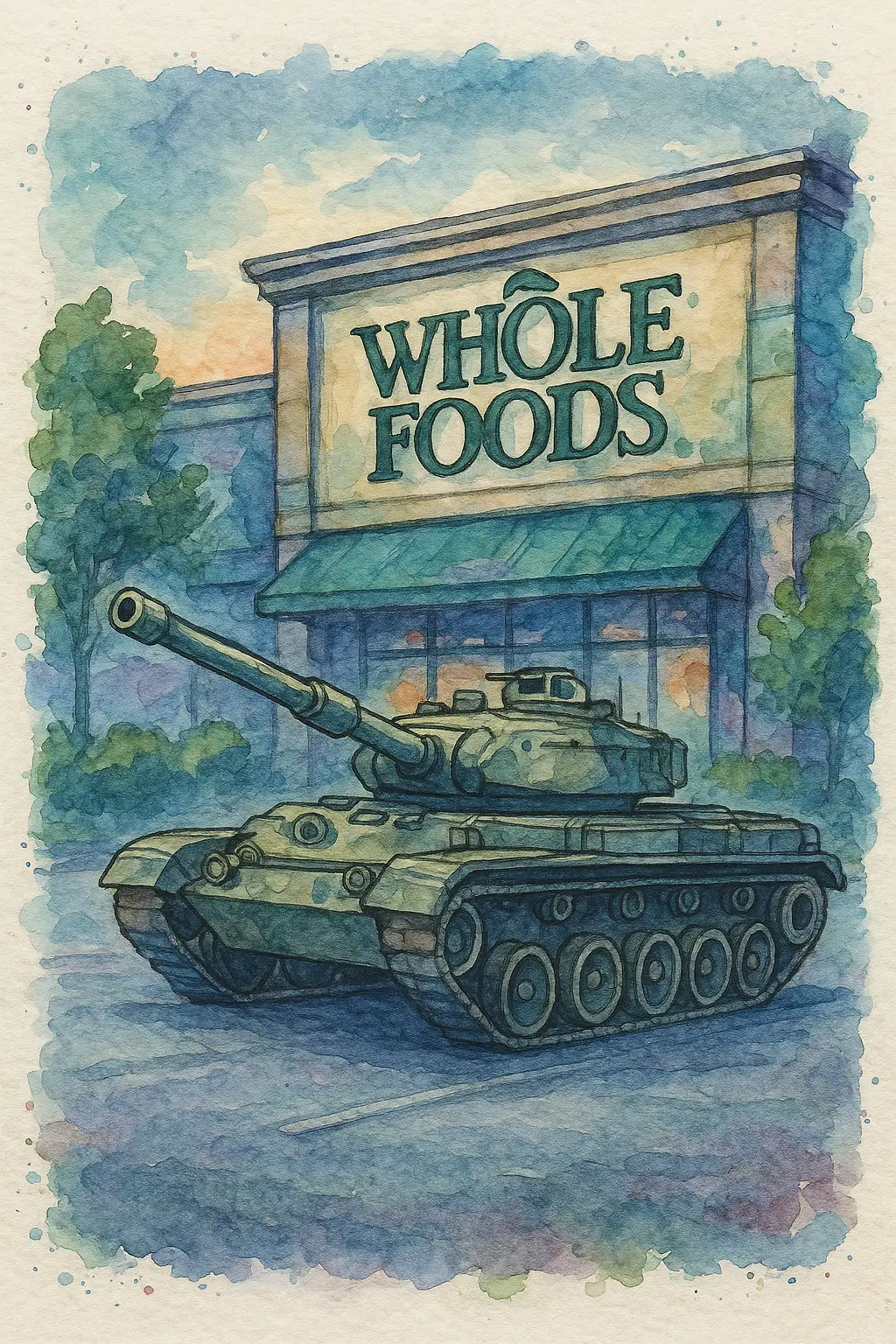
Imagine this: You walk outside for groceries and there’s a tank parked in front of your local Starbucks. A soldier watches you grab oat milk like you might be hiding an insurrection in your tote bag. Comforting? Or are your ancestors whispering, “Girl, we’ve seen this movie before”?
America has a long, sweaty history of pretending that soldiers on our own streets are just here to help. But every time boots hit the pavement, one question echoes louder than a National Guard rifle at a student protest:
Are they protecting us—or controlling us?
Let’s peel back the patriotic wallpaper and take a little guided tour through 250 years of “Don’t worry, it’s for your safety.”
America Was Born Screaming “Get Off My Lawn” at Redcoats
1770, Boston: British soldiers shoot five colonists for the crime of yelling and maybe throwing snowballs. The PR department dubbed it a “Massacre” (accurate), and it burned into our national brainstem: soldiers pointing guns at civilians is rarely a sign of liberty.
It wasn’t just a skirmish—it was the spark that lit a revolution, and the reason we got real jumpy about standing armies ever since. That gunpowder paranoia got baked into our laws. Spoiler: we’ve ignored it almost ever since.
The 19th Century—Now With Extra Violence
America’s young government wasted no time flipping the script:
- Whiskey Rebellion (1794): Farmers didn’t want to pay taxes. Washington sent troops. Guess who blinked first?
- Draft Riots (1863): Mostly poor folks didn’t want to fight a rich man’s war. Troops killed 100+ civilians in New York.
- Labor Strikes (1877–1914): When workers asked not to die in factories, the government said, “Cool motive, here’s a bayonet.”
In each case, the troops weren’t protecting people—they were protecting power. You don’t need a PhD to see the pattern: the government sent in soldiers when the poor got too loud.
20th Century—Same Boots, New Excuses
- Bonus Army (1932): Broke WWI veterans begged for benefits. The U.S. Army charged them on horseback. Tanks. Bayonets. Two dead.
- Kent State & Jackson State (1970): Students protested war. Soldiers shot to kill. It was “order,” if you define order as “dead teenagers.”
- Urban Riots (1960s–1992): Troops rolled into cities. Some felt safer. Many more were brutalized or killed. Law and order, baby!
Every time the country cracked under pressure, the government pulled out its favorite Band-Aid: boots and bullets. Not empathy. Not reform. Control.
Brief Glimpses of Not Being the Worst
- Little Rock (1957): Eisenhower sent the 101st Airborne not to silence protest, but to protect nine Black teenagers. Actual justice in uniform.
- Selma (1965): Johnson used troops to stop racist mobs from tearing marchers apart. Again, rare moment of constitutional clarity.
- Katrina (2005): Relief troops saved lives, even if FEMA was cosplaying incompetence.
- Post-9/11 (2001): Troops at airports felt like security—for about 10 minutes, until the surveillance state ballooned like a radioactive tick.
These moments worked because they flipped the usual power dynamic: troops shielded the vulnerable instead of threatening them.
But let’s not get too misty-eyed—these were the exceptions. History treated them like flukes.
2025 – The New Boss Is the Same as the Old Boss
Fast forward to now. Troops deployed in:
- Los Angeles
- Portland
- D.C.
- Memphis
- Chicago
All under the banner of “emergency” and “law and order.”
Here’s the reality:
- Lawsuits say it’s illegal.
- Judges agree.
- Citizens are injured.
- The communities “protected” are the ones being surveilled and stomped.
This isn’t Little Rock. This isn’t Selma. This isn’t even Katrina. This is cosplay fascism on a Red Bull drip.
The Pattern: Always the Same
- The government says “Don’t worry, we’re here to help.”
- Civilians bleed.
- Trust dies. Again.
The Real Question Isn’t ‘Can They Keep Order?’—It’s Whose Order They’re Keeping.
Yes, troops can bring order. They’ve been doing it for centuries.
But is it the order of rights being protected?
Or the order of mouths being shut?
In 1770, it was a massacre. In 1957, a miracle. In 2025… we’re teetering. Again.
The boots are on the ground. The question is: are they here to help you up—or hold you down?