Parsing Power and Predation in the Epstein Files
Content note: This piece discusses sexual abuse, trafficking, and institutional failure.
Of all the horrors and details in the new Epstein document dump, the line that broke containment online was not about a survivor. It was about a joke.
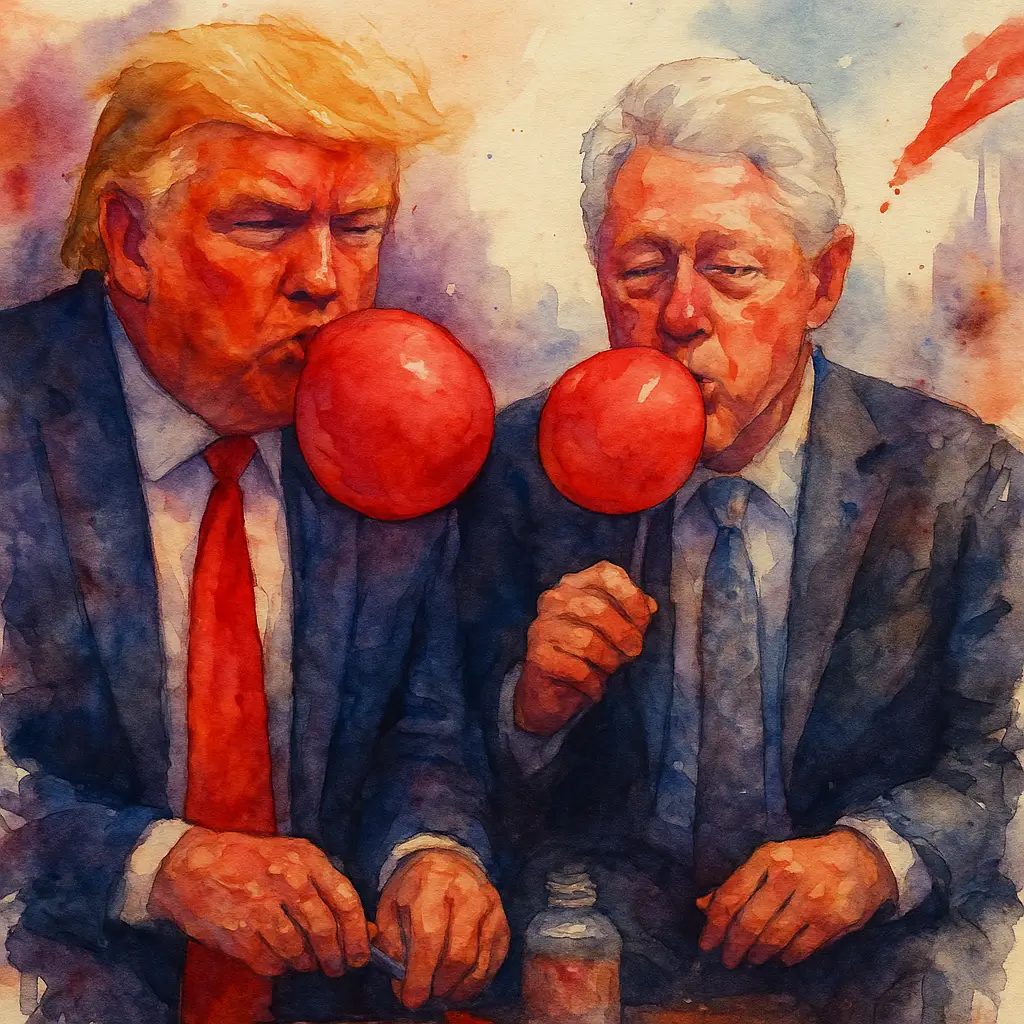
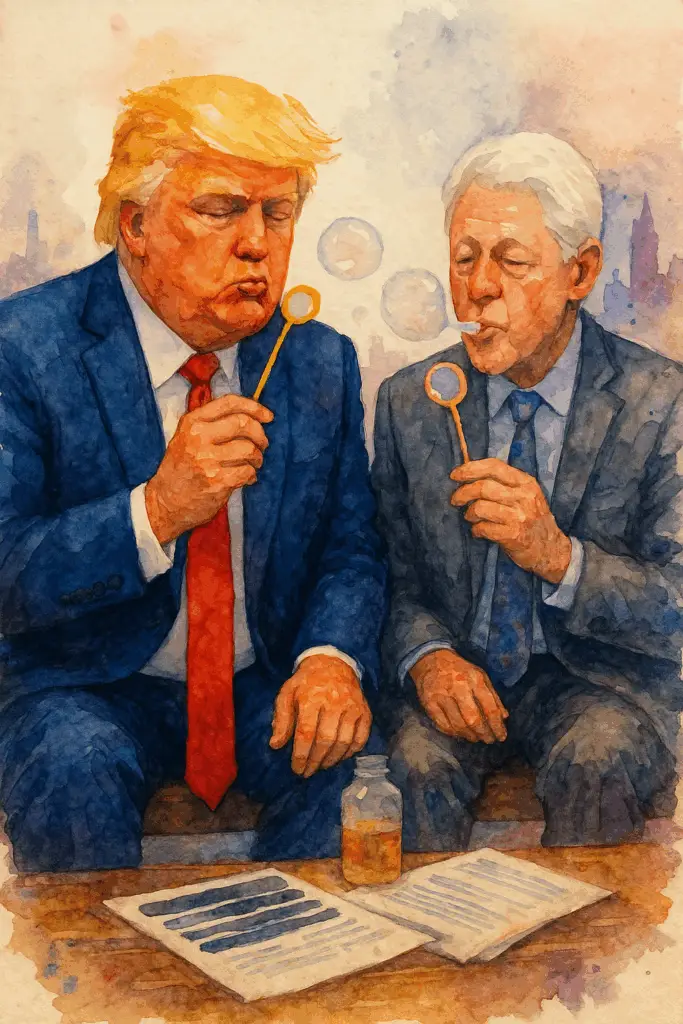
In a 2018 email, Mark Epstein tells his brother Jeffrey to ask Steve Bannon whether Vladimir Putin has “the photos of Trump blowing Bubba.”
That’s it. That’s the sentence.
The internet did the obvious math:
Trump + “Bubba” (a nickname long used for Bill Clinton) + Putin + “photos” = full conspiracy brain-melt.
Now that the email is public, Mark Epstein is suddenly very eager to say that “Bubba” is not Clinton, that this was a joke, that we should all unclench and stop picturing exactly what he chose to type and send.
Maybe he’s telling the truth.
Maybe he’s trying to smother a grenade for Trump.
Maybe he’s trying to smother a grenade for Trump, Clinton, and the whole shared ecosystem of men who would find that line “funny” in private and “deeply inappropriate” in public.
What we don’t have: an actual photo released to the public.
What we do have: proof that, inside this circle, the idea of “Trump blowing Bubba” is a thinkable piece of kompromat, dropped into an email and aimed at a man like Bannon.
And, as usual, the outrage machine is fixated on who might be embarrassed, not on who was hurt.
Meanwhile, outside that spectacle, something bigger is going on.
House Democrats and the Epstein estate have now dumped more than 20,000 pages of emails, calendars, call logs, travel manifests, financial ledgers, and assorted “little admin notes” into the public record.
If you zoom all the way out, the files show two parallel truths:
- A glittering social galaxy of presidents, billionaires, tech founders, royals, authors, and academics orbiting Jeffrey Epstein, sending birthday tributes and accepting invitations.
- A deliberate, resourced infrastructure for grooming, trafficking, and abuse.
The files add grim texture and receipts. But the core lesson is something survivors have been saying for years:
Power protects itself.
So the real question isn’t “who’s on the list?”
It’s: why are we still surprised?
The Illusion of Innocuous Contact
Across calendars, emails, and call logs, familiar names appear: former presidents, tech moguls, financiers, diplomats, and celebrities. Recent releases show Epstein actively scheduling meetings and outreach with figures like Peter Thiel, Bill Gates, Elon Musk, Steve Bannon, and others well after he was a registered sex offender.
Some examples of how people show up in this machinery:
- Donald Trump — In a newly released email, Epstein tells Ghislaine Maxwell that an alleged victim “spent hours at my house” with Trump, referring to Trump as the “dog that hasn’t barked.” Trump denies any wrongdoing, and his team insists the emails prove nothing.
- Bill Clinton & Donald Trump (again) — Both appear in Epstein’s 50th birthday “book,” a 238-page album of personal notes and jokes assembled by Maxwell, now released by the House Oversight Committee.
- Elon Musk, Bill Gates, Peter Thiel, Steve Bannon, Prince Andrew — Show up in calendars or estate documents for scheduled or proposed meetings, meals, flights, or even a potential island visit.
- Naomi Campbell and other celebrities — Appear in contact books, flight logs, and earlier court filings that are now bundled into the broader “Epstein files” conversation.
Here’s the key nuance the internet is grinding into paste:
Being in a contact book, a calendar, a flight log, or a birthday scrapbook is not the same thing as being named by survivors as a participant in abuse.
Those distinctions matter:
- A name in a document ≠ a charge in a court.
- Social proximity ≠ legal culpability.
- But social proximity absolutely does tell us something about how power clusters, launders reputations, and keeps certain people permanently “credible.”
The problem isn’t that every name is secretly “a client.”
The problem is that the network was robust enough to make that question plausible.
Grooming vs. Greetings
In the same stack where you find cute birthday quips from presidents, you also find operational language:
- Emails between Epstein and Ghislaine Maxwell coordinating “massages,” travel, and the arrival of young women.
- Flight logs and travel records documenting movements of underage girls alongside Epstein and associates, and the use of private jets and properties as staging grounds.
- Legal filings and testimony from survivors like Virginia Giuffre describing grooming, coercion, and repeated abuse.
- Event notes and calendars that put already-accused predators in close proximity to teens and young women at Epstein-linked locations.
These are not just “awkward social connections.”
They read like the back office of a criminal enterprise:
- who’s flying where,
- who’s staying where,
- who’s providing which “services,”
- and how to keep the adults with power comfortable while teenagers remain interchangeable and invisible.
Epstein’s wealth, and therefore his ability to move bodies and maintain this ecosystem, came largely from a tiny group of ultra-wealthy clients — especially Les Wexner and Leon Black, whose money, properties, and institutional access amplified his reach.
That doesn’t mean they signed off on rape in a memo.
It does mean their money was structurally entangled with a man who built his life around exploiting girls and young women.
What the Files Don’t Say — and Why That’s Still the Point
Critics are right about a few things:
- The documents are heavily redacted.
- Many items recycle prior court records and media reporting.
- There is no single neat “client list” spreadsheet, despite the meme-ified obsession over one.
If you came for a simple villain CSV, you’re going to be disappointed.
But focusing only on “who’s officially busted” misses the larger story these documents scream:
- We are looking at the machinery of impunity.
- How powerful men maintain access to each other even after convictions.
- How “plausible deniability” becomes a shared project.
- How institutions — banks, law firms, foundations, media, universities — circle wagons around a man everyone knew enough to avoid… but not enough to fully walk away from.
It’s no longer about a naughty list of individual monsters.
It’s about a system that made being monstrous a feature, not a bug — as long as you were polite at dinner and generous with donations.
In the Cult of Brighter Days, We Name the Pattern
Inside the Cult of Brighter Days, we don’t pretend this is a mystery thriller. We already know how the plot goes. Our job is to name the pattern clearly:
- Be Kind
Kindness here means centering the people who were harmed, not the reputations of those now scrambling to issue carefully lawyered statements. Survivors’ testimony is not “gossip” competing with famous names for screen time — it’s the heart of the story. - Be Funny (but don’t punch down)
There is deep, disgusting comedy in the spectacle of world leaders and billionaires trying to explain why their names keep popping up in the archives of a sex offender. That’s where the jokes go — at the hypocrisy, the PR spins, the “we barely knew each other” narratives.
The humor never lands on the bodies of trafficked kids. - Failure Is Mandatory
Systems fail. Institutions fail. We fail.
Part of our practice is owning that:- media looked away until the story became profitable,
- law enforcement accepted deals that prioritized comfort over accountability,
- and regular people, conditioned by celebrity and wealth, doubted survivors because the accused were “important.”
We do not treat these documents as sacred revelations. They are boring, bureaucratic evil — evidence of how harm dresses itself in:
- Outlook invites,
- donor lists,
- polite correspondence,
- and “hope this email finds you well” messages sent from island compounds and abuse houses.
So no — we’re not shocked.
We are tired.
We are furious.
And we are paying attention.
Not just hunting for a perfect, printable list of villains, but tracing the persistent pattern that keeps re-forming around every Epstein, every time:
- concentrated wealth,
- unaccountable institutions,
- and a culture more horrified by saying the quiet part out loud than by the abuse itself.
The Cult of Brighter Days doesn’t look away from that.
We keep naming it, even when the paperwork tries to bury it.